The City is Rumbling,
and so are You
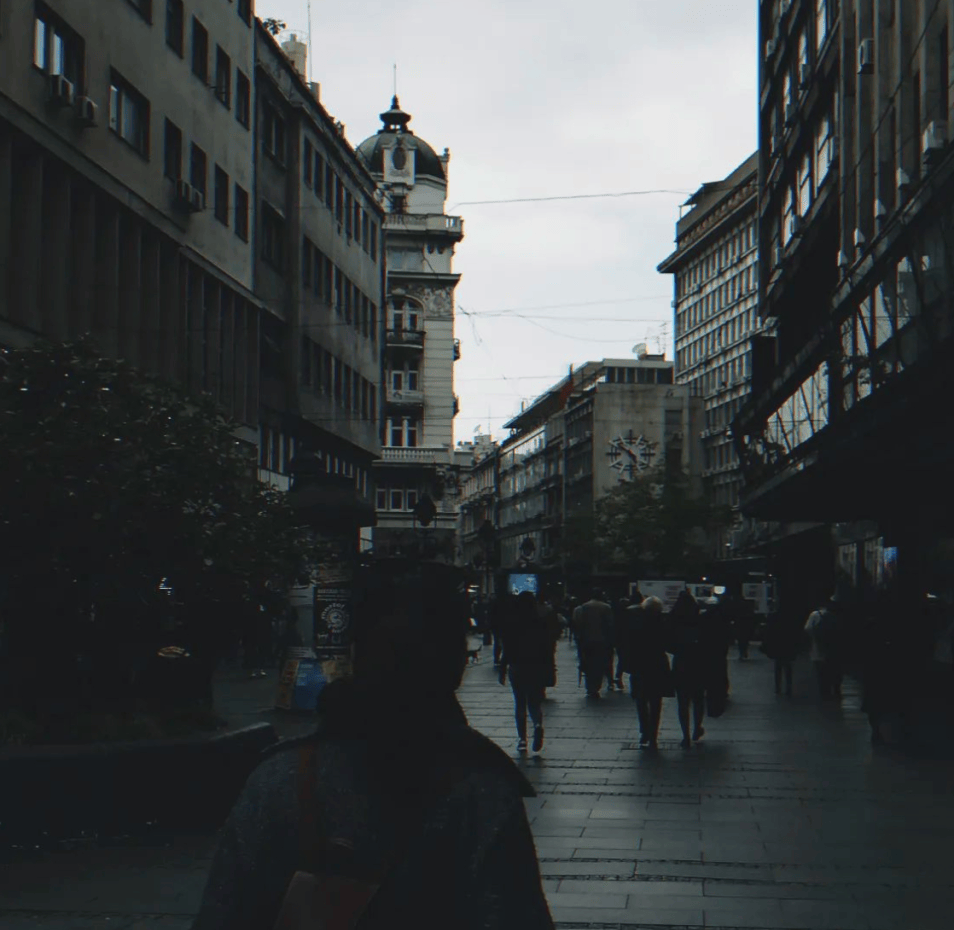
You are in the city right now, right after lunch on a Friday. Possibly downtown, right? Well, definitely yes. I mean, just listen – the cars honking in the distance mixed with the immediate sound waves coming from your high heels hitting the pavement. The street shops are crowded on a Friday and the air is constantly busy with smoke from who knows what, though it doesn’t even reach too high before being shredded by the noisy wings of pigeons. The benches are all occupied by exactly the same people who were there yesterday. There are probably thousands of passersby right now, and considering how everyone is in their own version of the city, it seems like a miracle that this very street works like one structured organism.
But you are also experiencing a different version of the city, aren’t you? You have lived here for as long as you can remember, but you keep noticing something new every day. New, yet the same. You’re way too dramatic. You’re tired of it, all of it. You live in one of the best cities in the world, but damn, it just feels so familiar and somehow mechanical, even at times when everything unfolding seems so unpredictable. At the end it always ends up being the same anyways.
You ARE dramatic. It’s a Friday afternoon, why don’t you calm down a bit? You’re pacing down the street, you seem kind of distressed. Are you overwhelmed by the massive crowd of people trying to cross the street at the same time as you? Or is it because you hear one of those bulldozer machines trying to crack the surface of the asphalt? It’s probably just the plumbing again.
Ah, I get it now. You’re trying to get to that fountain in the park, where everyone throws coins and wishes something out of touch. Wait, are you crying? I didn’t know fountains got you so emotional. It’s a nice one – large, made of stone, with water jets taking turns spraying into the air, some lower, others higher. It’s in the middle of the park, so quite distant from the urban noises. The sounds of the moving water leave behind every other sound.
You get closer, as close as possible. You close your eyes, and think about how much you want to get the hell out of there. But where would you go? Another city? It will certainly start feeling like a concrete nightmare after a while, just like this one. Somewhere in nature? What even is nature? You go to the park every day, it has trees and neatly trimmed patches of grass. In fact, you are there right now. Is this the closest to nature you can get?
You listen to the splashing water with sealed eyes, while your imagination replaces the vision of the fountain with something else. You can’t place it yet, but you focus as if you and the flowing water are the only things left in the world. You envision a world without a crowd dependent on machines to complete their daily tasks. You imagine being free from the urban agendas and enforced sensory overload of the city apparatus. Your mind transports your body somewhere else, but you can’t place it yet. It feels unfamiliar, it feels soothing but most importantly – it’s not in the city.
You realize you held your breath for a few seconds, and you inhale deeply. You expect the routine smell of engine waste, but instead your body gets fueled with the scent of thyme and pine. Confused, you open your teary eyes and you find yourself standing in front of a narrow, echoing river. The water is flowing fast like it has somewhere to be. Do you have somewhere to be? You certainly are somewhere right now, still confused. You look around only to notice the high, ungroomed trees and occasionally tall grasses. As far as your sight can reach, there seems to be nothing around, but green and brown scraping the bright blue sky.
You finally decide to move your feet and go towards the river. You lift your foot in the air and right when it confidently approaches the ground, your ankle twists aggressively and sends a spasm through your leg. Right, you’re wearing heels. Those aren’t a great addition to nature, but I will give you the benefit of the doubt since you didn’t exactly plan this trip. You’re still deciding whether you enjoy the whole situation. You did want to get away, but this? How will you find your way around here? A way to where, do designated areas even exist? How will you know what is hiding behind every tree? How can you make a single move, especially after hearing this suspicious sound coming from behind the bushes just a second ago? Not to worry you, but this aggressive fluttering of wings is not coming from pigeons. Those don’t come around here! You have to calm down – again. Maybe if you just stop pacing around, go back to that river, close your eyes and imagine just how much you want to get out of here, you will be back at the fountain within one thought away. You’re scared of closing your eyes because of what might approach you?
You’re right to be scared. We both just heard the loud roar coming from the wilderness. You’re starting to sweat and your eyes are filled with tears again. You’re looking around quickly, panicking, and it’s almost like your eyes are catching visions of the city in between the pine trees. Are you longing towards the city? The concrete nightmare you so eagerly wanted to escape for as long as your memory goes back? You’re not exactly sure about your feelings right now, but you are certain that your heart isn’t thriving here. Something about your body, your mind, your self being there, feels like a mismatch. It feels distant, foreign, it feels wrong.
Gazing into every corner of the woods makes you exhausted and you give in to your insecurity. You try sobbing, but even that isn’t working. You cup your whole face with both of your hands and just listen to the rustling of leaves, coming from unidentified sources. It could be anything, really. That thought speeds your heart up, and you swallow heavily. And there, somewhere along the heartbeats, you hear the soft and rhythmic melody of a blackbird. You recognize the song immediately, as it sounds identical to the bird that sings every morning from your office balcony. The melody takes your mind back to the building of your company. You think about the times when you have a headache at work and you point your sight to the street under your office. You look at the city, the people, the stories, the small birds visiting the city. Every time you look through the window something different happens. Different, yet the same. Unpredictable, yet familiar. That’s how you’ve known it for years. Only now your mind brings your consciousness back to those moments.
Deep into your thoughts, you notice that the scent of thyme in the air is disappearing. Although your hands are still cupping your face, you recognize the thick smells from all kinds of entities. You can smell car fumes, the cigarettes, the hot dog stand, even the dense dust from the construction down the street. You still hear the gentle rustling of leaves, accompanied by the bird’s song. You’re certain that somewhere in the distance there is another sound, and while it sounds familiar, you can’t seem to place it just yet. But it’s coming closer, and closer and closer. Aha! Did you hear it, that crazy loud bang! Of course you heard it, your face snapped out of your hands, and your eyes are now fully open! You wonder what that was? Just the crane at the construction site, it must have dropped something really heavy and big. Oh, welcome back by the way – you’re back at the city park fountain!
You look around – nothing has changed. What could possibly change? It’s been the same since forever. You wish you could just get out of there. Can you even get out of there? You walk towards the nearest bench and sit down. You hear the traffic in the distance, people talking out loud, pigeons flying around the lady that feeds them every day. You hear the blackbird again and wonder how could you love and hate being in this city at the same time?
On Familiarity, Routine, and the Desire to Experience the City Differently
Every day, cities become witnesses of millions, if not billions of completely unrelated to each other scenes, performed by the everyday citizen. While each citizen inhabits their own reality, one thing remains mutual – the urban space they perform at. Well, it’s not exactly “mutual” per se, since everyone embodies the city from their own perspective, but all the tools necessary for this embodiment are routine elements, commonly associated with the city environment. Some very visible examples include buildings designated to public affairs, traffic lights, pedestrian features such as benches, or construction machinery, such as cranes. These diverse components come together in order to create a city apparatus through its “expressions” of sounds, smells and visual cues, which sometimes guide citizens into a pattern of embracing and remembering the city.
Sometimes, these components are small, and we don’t recognize them as a familiar urban association immediately. It often takes a moment of suspense, a moment of looking away to truly feel the character of the familiar sensory wave. It took moving to a new country for me to realize that, and it was nothing else but the sound of a chainsaw. Cutting wood before the winter season is so common in my home country that we are used to hearing it every early morning around the end of August to September. I didn’t realize how much the sound reminded me of home before I randomly heard a chainsaw once here in the Netherlands, for the first and last time. What the chainsaw means for me, for other people that might be the smell of a chimney coming from the only house in the neighborhood, the rustling of leaves from one specific tree, or…the song of a blackbird that’s somehow always there.
All of this sounds very romantic, considering that most of the components that we associate our supposed “homes” with essentially make us feel kind of trapped, don’t they? Hearing, smelling or seeing something almost daily creates a routine, which leads to predictability and suffocation. Sociologist Maxime Felder explores that while familiarity with an urban environment can give us a sense of safety and a sense of space, it can also deprive us of the excitement of discovery to the point of wanting to escape the usual, or even move away entirely. Simultaneously, he explores how stepping out of familiar environments can trigger a feeling of being unsafe, and not necessarily because it is unsafe but because we do not know what the “risks” are or how to handle them.
But how could we feel both so attached and so suffocated by a place at the same time? Well, to answer this question, maybe we could try and see how we can experience the city differently every once in a while. Because at the end, the desire to escape isn’t always a desire to leave a place entirely – sometimes it’s a desire to experience it differently. And while we don’t have control over the sensory overload coming from the urban components, we do have control in experimenting with different environments and associating specific citizen performances to them. Another reason why a city becomes so familiar in the first place is because we unconsciously choose to give certain roles to urban areas – we designate them in a way that fits our emotional, or practical demands. In other words, we turn a place into a personal map through repetition. For example, whenever I had a university class in a particular part of the city center, I would walk between the train station and the same building before and after class. I always took the same side of the road, partly because the other side was interrupted by so many side streets branching off towards the main road. Taking that route meant fewer crossings and fewer interruptions. Eventually, I stopped thinking about which side to take. It simply became my side of the road.
Of course, we don’t have to pretend that our lives will change dramatically by simply taking a different route to our errands. But just consider doing that once, because you never know what could discover next. You never know what could happen if you listen and identify a different sound that you’ve never heard before. Or, if you decide to park your car or bike somewhere slightly further next time, or sit on a bench that you always pass. The city is a stage and we are the actors.

